
Propecia (finasteride 1mg) lawsuits allege that Merck failed to adequately warn consumers about the risk of persistent sexual dysfunction, depression, and cognitive impairment — side effects that in some cases continue long after stopping the medication. This litigation remains active.
Current Status
What Plaintiffs Allege
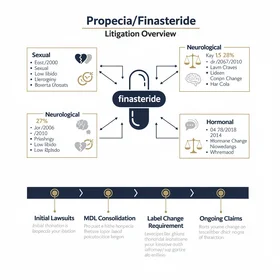
The central allegation is that Merck knew or should have known about the risk of persistent side effects — including sexual dysfunction that continues after discontinuing finasteride — and failed to include adequate warnings on the product label. Specific alleged injuries include:
- Persistent sexual dysfunction — erectile dysfunction, loss of libido, reduced sensation that continues months or years after stopping Propecia
- Post-Finasteride Syndrome (PFS) — a constellation of sexual, neurological, and psychological symptoms reported by former finasteride users
- Depression and cognitive effects — brain fog, memory impairment, anxiety, depression
- Suicidal ideation — reported by some former users in conjunction with depression and sexual dysfunction
The Legal Landscape
The Propecia MDL (Multi-District Litigation #2331) is centralized in the Eastern District of New York. Unlike many pharmaceutical mass torts that have resolved through global settlements, Merck has contested these claims aggressively. Bellwether trials have been hotly disputed, with Merck challenging causation evidence.
The litigation's prolonged timeline has been driven partly by the evolving scientific understanding of post-finasteride syndrome — a condition that was not widely recognized when the earliest lawsuits were filed but has gained increasing attention in peer-reviewed literature.
Who May Have a Claim
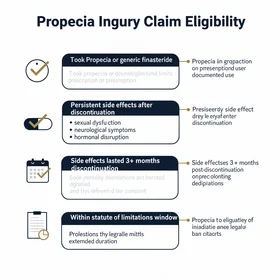
You may be eligible to file a Propecia lawsuit if:
- You took Propecia (finasteride 1mg) or generic finasteride for hair loss
- You experienced sexual dysfunction, depression, cognitive changes, or other significant side effects
- Your symptoms persisted after stopping the medication
- Your state's statute of limitations has not expired
Mass Tort vs. Class Action vs. Individual Lawsuit
Propecia claims proceed as a mass tort (MDL), not a class action. Here is how these approaches compare:
| Factor | Mass Tort (MDL) | Class Action | Individual Lawsuit |
|---|---|---|---|
| Individual damages | Yes — each case valued separately | No — one recovery for all | Yes — fully individual |
| Control over case | Moderate — shared pretrial | Minimal — lead counsel decides | Full control |
| Cost to plaintiff | Low (contingency) | Low (shared fees) | High if hourly |
| Timeline | 3–10 years typical | 2–5 years | 1–3 years |
| Strength in numbers | Strong — consolidated discovery | Strongest | Weakest |
How to File a Propecia Claim: Step by Step
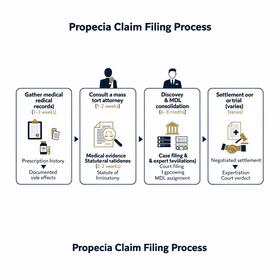
If you believe you have a Propecia injury claim, here is the process for getting started:
- Contact us for a free case evaluation — describe your symptoms, when you took finasteride, and how long effects have persisted
- Medical records review — our attorneys will request and review your prescription history and medical records documenting your symptoms
- Case qualification — attorneys assess whether your injuries meet the criteria for the active MDL and whether the statute of limitations in your state permits filing
- Engagement and filing — if your case qualifies, you sign a contingency agreement and your attorneys file your individual claim within the MDL
- Discovery and pretrial — your case joins the consolidated pretrial proceedings, including shared expert depositions and document discovery
- Resolution — cases resolve through individual settlement negotiations or bellwether trial outcomes that inform settlement values for similar claims
Alternatives to Filing a Lawsuit
Instead of litigation, consumers harmed by Propecia have other options to consider:
- FDA MedWatch reporting — report adverse drug reactions to the FDA even if you don't pursue legal action. These reports contribute to the safety data that drives label changes and regulatory action.
- Contacting Merck directly — the manufacturer has a medical information line for reporting adverse events. This creates a record but typically does not result in compensation.
- State attorney general complaint — consumer protection divisions in many states investigate unfair or deceptive marketing by pharmaceutical companies.
- Support organizations — the PFS Foundation provides medical research advocacy and connects patients with physicians who specialize in post-finasteride syndrome management.
- Insurance dispute resolution — if your insurer denied coverage for treatment of finasteride-related injuries, internal appeals and state insurance commissioner complaints are alternative paths.
Free Case Evaluation
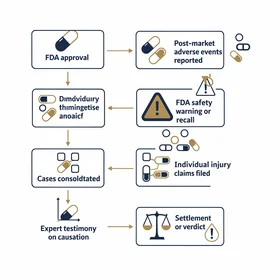
If you or someone you know experienced persistent side effects from Propecia, contact us for a free, confidential case evaluation. There is no cost and no obligation. Our attorneys work on a contingency basis — you pay nothing unless compensation is recovered. For general legal questions beyond pharmaceutical claims, visit Montgomery Legal.